
Absolutely. For your portfolio, the video-editing article should show that you understand editing as storytelling and marketing, not just “I know Premiere Pro.” The latter is not exactly a personality.
Here’s a polished 2026-focused version designed to position you as a Video Editor + Digital Marketer. Video Editing in 2026: When Every Second Has a Purpose
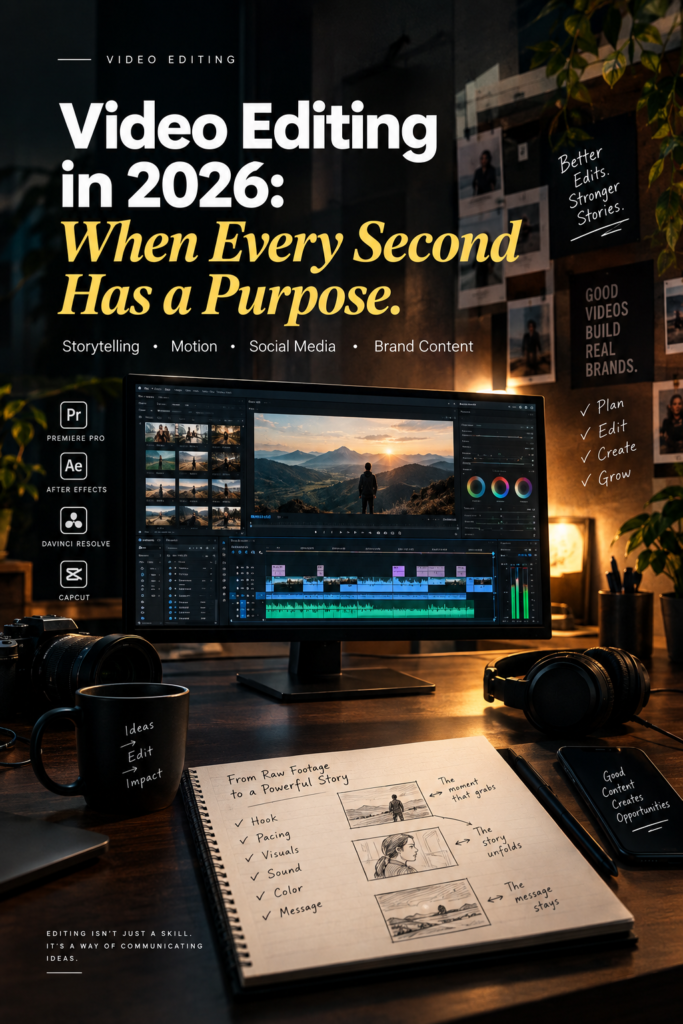
Video Editing in 2026: When Every Second Has a Purpose
Video Editing | Storytelling • Motion • Social Media • Brand Content
We live in a world where people can scroll past a video in less than a second.
That means video editing is no longer simply about cutting clips together, adding music, and making everything look cinematic.
It is about earning attention, controlling emotion, communicating a message, and giving every second a purpose.
In 2026, video is everywhere.
Brands use it to sell.
Creators use it to build communities.
Businesses use it to explain.
Marketers use it to convert.
And audiences use it to learn, discover, compare, and decide.
The difference between an average video and a memorable one often comes down to what happens between the frames.
What Video Editing Really Means
Video editing is often described as a technical process:
Cut → Arrange → Add Music → Color Grade → Export
But that is only the surface.
The real process is about making decisions.
Which shot should appear first?
When should the cut happen?
How long should the viewer see a frame?
Where should the music change?
When should text appear?
When should the screen become quiet?
When should the story speed up?
When should it slow down?
Every decision changes how the audience experiences the video.
That is why editing is not simply about software.
Editing is visual communication.
The First Second Matters
Social media has completely changed how videos are consumed.
A viewer doesn’t usually sit down and say:
“I am now prepared to watch this beautifully edited 47-second production.”
They are scrolling.
And scrolling is ruthless.
The opening needs to create enough curiosity to make someone stop.
That might happen through:
- A strong visual
- A surprising statement
- A question
- Movement
- A dramatic sound
- A close-up
- A visual transformation
- A compelling problem
- A powerful first frame
The hook doesn’t need to be loud.
It needs to be relevant.
A beautiful opening that says nothing can still lose the viewer.
A simple opening that creates curiosity can win them.
Editing Is About Rhythm
Every video has a rhythm.
Some scenes need to move quickly.
Others need room to breathe.
Fast cuts can create:
Energy → Excitement → Urgency
Longer shots can create:
Emotion → Focus → Atmosphere
The editor’s job is to understand when the audience needs each one.
Music can influence that rhythm.
So can dialogue.
So can movement.
So can silence.
Sometimes the most powerful editing decision is knowing when not to cut.
Story Comes Before Effects
Modern editing software gives us an absurd number of effects.
Transitions.
Glows.
Particles.
Motion graphics.
3D effects.
Speed ramps.
Camera shakes.
Blur.
Masks.
AI tools.
And approximately seventeen thousand ways to make a perfectly good video look like a gaming montage from 2014.
Effects are useful.
But they should support the story.
A transition should have a reason.
A visual effect should improve communication.
Motion graphics should make information easier to understand.
Color should reinforce the mood.
The question should never be:
“What effect can I add?”
It should be:
“What does this moment need?”
Short-Form Video Has Changed Editing
Short-form video has created a completely different editing language.
Platforms such as Instagram Reels, YouTube Shorts, and TikTok reward content that can communicate quickly.
That means editors increasingly need to think about:
Hook
Give the viewer a reason to stay.
Pacing
Remove unnecessary moments.
Pattern Interrupts
Change visuals, framing, movement, or sound before attention disappears.
Captions
Make important information understandable even without sound.
Visual Hierarchy
Make the most important information impossible to miss.
Retention
Give viewers a reason to continue watching.
The objective isn’t simply to make a short video.
It is to make a video that doesn’t feel long.
Video Editing Meets Digital Marketing
This is where video becomes especially powerful.
A video isn’t always created just to entertain.
Sometimes it has a business objective.
It might need to:
- Build brand awareness
- Generate leads
- Sell a product
- Explain a service
- Increase engagement
- Build authority
- Introduce a brand
- Educate an audience
- Drive traffic
- Improve conversions
That changes how the video should be edited.
For example, a product advertisement may need to show the product immediately.
An educational video may need clear information hierarchy.
A personal-brand video may depend heavily on personality and storytelling.
A cinematic brand film may prioritize atmosphere and emotion.
The objective determines the edit.
The Psychology Behind a Good Edit
Great editing is partly technical.
It is also psychological.
Viewers constantly make tiny decisions:
Should I keep watching?
Do I understand this?
Is this interesting?
Can I trust this?
What happens next?
A good editor understands these questions without making the viewer consciously think about them.
That can involve:
- Visual anticipation
- Timing
- Contrast
- Sound design
- Framing
- Pacing
- Color
- Information density
- Emotional progression
The best editing often feels invisible.
The viewer doesn’t notice the cuts.
They simply experience the story.
Sound Is Half the Experience
Visuals get most of the attention.
Sound often does the hidden heavy lifting.
A good soundtrack can change the emotional direction of a scene.
A carefully placed sound effect can make a transition feel physical.
A sudden silence can create tension.
Dialogue can establish personality.
Ambient sound can make a scene feel real.
This is why professional editing isn’t only about what the viewer sees.
It is also about what they hear.
A video with beautiful visuals and weak audio can still feel amateur.
Color Creates Emotion
Color grading isn’t simply about making footage look “cinematic.”
Color helps establish identity and mood.
Warm tones can create feelings of comfort, nostalgia, or energy.
Cooler tones can create distance, calmness, or tension.
High contrast can create a dramatic visual language.
Soft tones can create a more natural feeling.
But there is no universal cinematic preset.
The right grade depends on:
Story + Brand + Lighting + Subject + Mood
Color should support the story rather than compete with it.
AI Is Changing the Editing Workflow
AI is becoming an important part of modern post-production.
Editors can now use AI-assisted tools for tasks such as:
- Transcription
- Caption generation
- Silence removal
- Background cleanup
- Object removal
- Audio enhancement
- Masking
- Rotoscoping
- Search and organization
- Generating creative variations
- Reframing content for different formats
This can dramatically reduce repetitive work.
But faster editing does not automatically mean better editing.
AI can help with execution.
The editor still needs to decide:
What should the audience feel?
What should they remember?
What should they do next?
Technology can speed up the process.
Creative judgment gives the process direction.
Editing for Different Platforms
One video doesn’t necessarily work everywhere.
A cinematic YouTube video, Instagram Reel, LinkedIn video, advertisement, and website hero video may require completely different approaches.
Instagram Reels
Fast hooks, captions, visual movement, strong pacing.
YouTube
Longer storytelling, deeper context, stronger narrative structure.
Clear communication, professional storytelling, educational value.
Paid Ads
Immediate relevance, strong messaging, product or benefit visibility, clear CTA.
Brand Films
Atmosphere, emotion, visual identity, cinematic storytelling.
The platform changes the viewing environment.
The edit should adapt with it.
From Raw Footage to Final Story
A professional editing workflow is more than dragging clips onto a timeline.
A typical process can look like:
01. Understand
Study the purpose, audience, message, and platform.
02. Organize
Review footage, audio, graphics, and assets.
03. Select
Find the strongest moments.
04. Build
Create the first version of the story.
05. Refine
Improve pacing, structure, and clarity.
06. Design
Add typography, graphics, transitions, and visual details.
07. Sound
Balance dialogue, music, ambience, and effects.
08. Color
Create visual consistency and mood.
09. Optimize
Adapt the final video for the required platform.
10. Review
Watch it again from the perspective of the audience.
The final export is only the visible result.
The real work happens in the decisions leading to it.
A Good Edit Removes More Than It Adds
One of the hardest lessons in editing is learning what to remove.
You may have a beautiful shot.
You may have an interesting transition.
You may have an impressive effect.
You may have a clip that took an hour to create.
None of that means it belongs in the final video.
Every unnecessary second competes with the story.
Every unnecessary effect competes with the message.
Every unnecessary word competes with the viewer’s attention.
Good editing isn’t only about adding.
It is about knowing what deserves to stay.
The Future of Video Editing
Video creation is becoming faster.
AI is accelerating workflows.
Cameras are becoming more accessible.
Editing software is becoming more powerful.
Content production is becoming easier.
That means technical access is no longer the biggest advantage.
When almost everyone can create a technically acceptable video, differentiation moves toward:
Storytelling.
Taste.
Strategy.
Originality.
Consistency.
Understanding the audience.
The editor of the future isn’t simply someone who knows how to use editing software.
It is someone who understands why the edit works.
My Approach to Video Editing
I believe video should have a purpose before it has an effect.
My approach combines storytelling, visual design, pacing, sound, and marketing strategy to create content that is not only visually engaging but also meaningful.
My process is simple:
Understand
Identify the audience, message, platform, and objective.
Plan
Build the visual and storytelling direction before editing.
Edit
Shape the raw footage into a clear and engaging narrative.
Enhance
Use motion graphics, typography, sound design, transitions, and color to strengthen the story.
Optimize
Adapt the final video for the platform and audience.
Improve
Review performance and learn what can make the next piece stronger.
Because every video is an opportunity to communicate something better.
Final Thoughts
Video editing isn’t about making footage look complicated.
It is about making a message impossible to ignore and easy to understand.
The best edit may contain hundreds of decisions that the viewer never notices.
A cut.
A pause.
A sound.
A frame.
A word.
A movement.
A moment of silence.
Individually, they may seem insignificant.
Together, they create an experience.
And in 2026, when audiences have more content than ever competing for their attention, the editor’s greatest skill isn’t knowing how to add more.
It is knowing what matters.
Because every frame has a purpose.
Every second has value.
And every great video has a story worth remembering.