
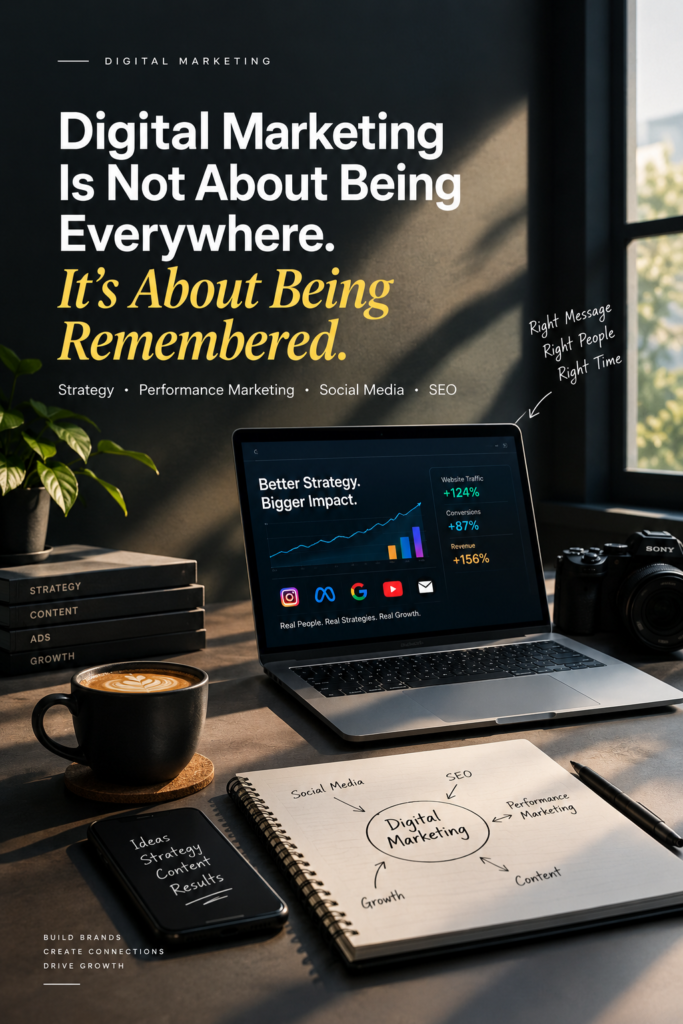
The digital marketing game has changed. The goal is no longer simply to get noticed. It is to become trusted, remembered, and chosen.
Digital marketing used to be relatively simple.
A brand created a website, optimized it for Google, posted regularly on social media, ran some ads, and watched the numbers move.
Then AI arrived.
Search became conversational. Social platforms became search engines. Short-form video became a discovery channel. Advertising platforms became increasingly automated. Customers started asking AI tools for recommendations before they ever visited a company’s website.
In 2026, the biggest challenge for marketers is no longer getting attention.
It is turning attention into trust, action, and measurable business growth.
And that changes almost everything.
The New Digital Marketing Reality
Marketing has entered an era where content can be created faster than people can consume it.
AI can generate headlines, images, videos, ad variations, emails, product descriptions, social posts, and even campaign ideas in seconds.
That sounds like a marketer’s dream.
It can also become a content nightmare.
When everyone can produce more content, content itself becomes less scarce.
The advantage shifts toward businesses that can create something much harder to automate:
Relevance. Credibility. Personality. Experience. Trust.
In 2026, the strongest digital strategies are not built around one platform. They connect multiple parts of the customer journey:
Discovery → Attention → Trust → Conversion → Retention → Advocacy
That is where modern digital marketing becomes more interesting.
1. AI Is Changing Marketing, Not Replacing Marketers
AI has moved beyond being a simple content-generation tool.
It is increasingly being used for research, audience analysis, creative testing, campaign optimization, personalization, reporting, and automation.
Industry research for 2026 shows marketers are increasingly integrating AI into everyday marketing workflows, while first-party data is becoming more important for activation and measurement.
But there is an important distinction:
AI can accelerate execution. It cannot automatically create a great strategy.
A marketer still needs to understand:
- Who is the customer?
- What problem are they trying to solve?
- Why should they trust this brand?
- What makes the offer different?
- What message will actually move them to act?
- What happens after the click?
The future is therefore not AI versus marketers.
It is marketers who use AI effectively versus marketers who don’t.
The tool is not the strategy.
The thinking behind the tool is.
2. SEO Is Evolving Into Something Bigger
For years, SEO was largely about ranking pages for keywords.
That still matters.
But search behaviour is expanding beyond traditional search results.
People increasingly discover information through AI-powered search experiences, social platforms, videos, communities, and conversational tools.
Google itself now documents AI features as part of Search and has introduced mechanisms such as preferred sources for AI Overviews and AI Mode.
This creates a new question for brands:
Can people find you when they search, and can AI systems understand why your brand deserves to be mentioned?
That is where concepts such as Answer Engine Optimization (AEO) and Generative Engine Optimization (GEO) are becoming increasingly relevant.
The goal is no longer only:
“How do I rank #1?”
It becomes:
“How do I become a useful, trustworthy source that search engines and AI systems can understand?”
That requires better content.
Not more content.
Better content.
3. Social Media Has Become a Discovery Engine
Social media is no longer just a place where brands publish updates.
It has become part search engine, part entertainment platform, part shopping environment, and part customer-service channel.
In India especially, the customer journey is increasingly moving from scroll → discover → evaluate → message → purchase.
Meta’s 2026 research on Indian commerce highlights the growing role of AI, Reels, creators, and conversational messaging in product discovery and shopping.
This means brands need to think beyond follower counts.
A post with 100,000 views means very little if it reaches the wrong people.
Meanwhile, a smaller piece of content that reaches the right audience, creates trust, and generates qualified enquiries can produce significantly more business value.
The question is therefore not:
“How many people saw this?”
It is:
“What happened because they saw it?”
4. Short-Form Video Is No Longer Optional for Many Brands
Attention has become visual.
People discover products through Reels.
They discover businesses through YouTube Shorts.
They learn through quick educational videos.
They compare products through creators.
They make buying decisions after seeing something that appeared in their feed.
This has created a new advantage for marketers who can combine:
Strategy + Storytelling + Editing + Performance
A good video does not simply look attractive.
It has a job.
It might:
- Stop the scroll
- Explain a problem
- Demonstrate a product
- Build credibility
- Handle an objection
- Create desire
- Generate an enquiry
- Drive a purchase
The best creative is not necessarily the most beautiful.
It is the creative that moves the audience forward.
5. Performance Marketing Is Becoming More Intelligent
Performance marketing has traditionally focused heavily on metrics such as:
CPC → CTR → CPA → ROAS
Those numbers still matter.
But modern marketers need to look further.
A campaign can generate cheap clicks and still produce terrible customers.
A campaign can have an impressive ROAS and still fail to create sustainable growth.
That is why metrics such as these become increasingly important:
- Customer Acquisition Cost
- Conversion Rate
- Customer Lifetime Value
- Repeat Purchase Rate
- Contribution Margin
- Lead Quality
- Revenue per Customer
- Retention
The goal is not simply to make an advertisement perform.
The goal is to build a profitable customer acquisition system.
That distinction separates advertising from marketing.
6. First-Party Data Is Becoming More Valuable
The internet is becoming increasingly privacy-conscious.
For marketers, this creates a fundamental shift:
You cannot build your entire growth strategy around data you don’t control.
First-party data includes information a business collects directly from its customers and audience with appropriate consent.
Examples include:
- Email subscribers
- CRM data
- Website interactions
- Customer purchase history
- WhatsApp opt-ins
- Loyalty programmes
- Lead forms
- Customer preferences
The value of this data is not simply having a spreadsheet full of names.
The real value comes from being able to understand customers and communicate with them responsibly.
2026 marketing research increasingly highlights first-party data as a foundational capability for activation and measurement.
The smartest brands are therefore building audiences they can continue to communicate with, rather than renting attention forever.
7. Content Marketing Has One New Problem
There is more content than ever.
And somehow, there is also less worth reading.
Humanity has achieved the remarkable feat of creating an infinite amount of content while simultaneously complaining that nobody reads it.
AI has accelerated this problem.
Generic articles can now be produced at enormous scale.
So what makes content valuable?
Original thinking.
Useful content should contain at least one of these:
- Real experience
- Original research
- Strong opinions supported by evidence
- Practical frameworks
- Case studies
- Examples
- Data
- Unique perspectives
- Human stories
The future of content marketing is not:
“Publish more.”
It is:
“Give people a reason to remember you.”
8. The Customer Journey Is No Longer a Funnel
The traditional funnel looked something like this:
Awareness → Consideration → Conversion
Real customers are considerably less cooperative.
They see a Reel.
Then a YouTube video.
Then a Google search.
Then a Reddit discussion.
Then an Instagram profile.
Then a review.
Then an AI-generated recommendation.
Then they disappear for three weeks.
Then they return through an advertisement.
Then they send a WhatsApp message.
Then they buy.
The modern customer journey is messy because humans are messy.
A successful digital marketing strategy therefore needs to connect different touchpoints rather than treating every platform as an isolated channel.
9. Personal Branding Is Becoming a Competitive Advantage
People don’t always trust logos.
They trust people.
That is why founders, creators, experts, designers, marketers, consultants, and employees are becoming important parts of brand communication.
A personal brand can make a business feel:
Human. Familiar. Credible. Memorable.
This doesn’t mean every business owner needs to become an influencer.
It means brands should stop hiding behind corporate language when a real human perspective could communicate the message better.
Sometimes the strongest marketing asset isn’t another advertisement.
It’s the person behind the business.
10. The Real Skill: Connecting Creativity With Data
Creativity without strategy can become decoration.
Data without creativity can become boring.
Performance marketing without brand building can become expensive.
Brand marketing without measurement can become difficult to justify.
The strongest marketers connect all of them.
Creative thinking creates attention.
Content builds understanding.
SEO and AEO create discoverability.
Social media builds relationships.
Performance marketing accelerates acquisition.
Analytics reveals what is working.
First-party data strengthens the relationship.
And strategy connects everything.
That is what modern digital marketing should look like.
So, What Does Digital Marketing Look Like in 2026?
It looks less like managing individual platforms and more like building a connected growth system.
A modern digital marketing strategy might look like this:
01 — Discover
Use SEO, AEO, social search, creators, and paid media to get discovered.
02 — Attract
Create content that earns attention instead of interrupting it.
03 — Educate
Answer questions, solve problems, demonstrate expertise, and remove uncertainty.
04 — Convert
Use landing pages, offers, funnels, messaging, and performance campaigns to turn interest into action.
05 — Measure
Track business outcomes, not vanity metrics.
06 — Retain
Build email, WhatsApp, CRM, community, and loyalty systems.
07 — Improve
Use data, experimentation, and AI to continuously improve the entire system.
That is the difference between doing digital marketing and building digital growth.
The Future Belongs to Adaptive Marketers
Nobody knows exactly what the digital landscape will look like five years from now.
That is probably for the best. Humans already struggle to predict what happens next Tuesday.
But one thing is clear:
The platforms will change.
The algorithms will change.
AI models will change.
Advertising systems will change.
Consumer behaviour will change.
The marketers who remain valuable will be the ones who know how to adapt.
Because digital marketing is not really about mastering Instagram, Google, Meta Ads, SEO, or AI.
Those are tools.
The real skill is understanding people.
Understanding what they want.
Understanding what they fear.
Understanding what makes them trust.
Understanding what makes them act.
And then building a system that connects those insights to measurable business results.
Final Thought
In 2026, attention is everywhere.
Everyone is publishing.
Everyone is advertising.
Everyone is using AI.
Everyone wants growth.
So the competitive advantage is no longer simply being louder.
It is being more relevant, more useful, more credible, and more human.
The future of digital marketing isn’t about replacing humans with technology.
It is about using technology to give good marketers more time to do the things machines still struggle to understand:
Think. Create. Connect. And build trust.
And ultimately, that is what marketing has always been about.